

Sunlight: The Most Underrated Longevity Tool
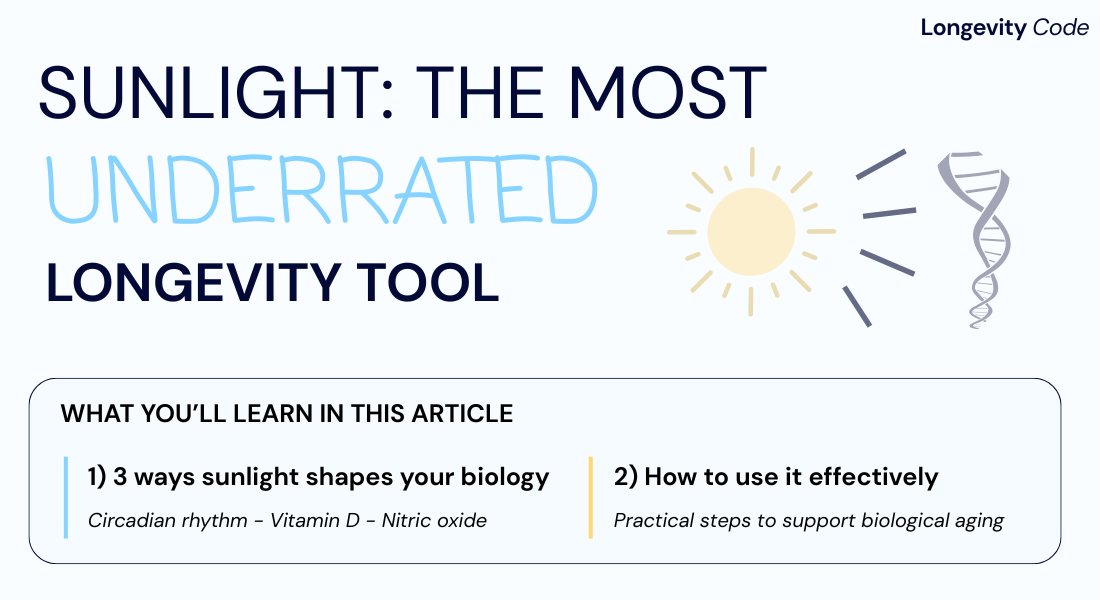
3 ways sunlight programs your biology - and how to use it effectively

For most of human history, life was governed by natural light.
We woke with the sun, spent most of our days outside, and slept when it got dark.
Today, our living environment looks completely different - but our biology is still running on the same ancient hardware, expecting light signals many of us no longer receive.
What’s becoming increasingly clear is how deeply sunlight shapes human biology and health. And the more we learn, the more it seems we’re only scratching the surface of how important that relationship really is.
In this article, I’ll break down 3 key ways sunlight influences your biology - and how research suggests we can use it to support healthy aging.
1) CIRCADIAN RHYTHM
Morning light sets your master biological clock.
When morning light enters your eyes, it’s detected by special cells in your retina called ipRGCs. These cells are especially sensitive to blue morning light (~480nm).
They send a signal straight to your brain’s “master clock” (the SCN), which then tells your body what time it is and helps set your daily biological rhythm.
From there, thousands of processes are timed and coordinated - cortisol release, melatonin production (for sleep), metabolism, immune activity, and cellular repair.

Roughly 40-50% of our genes follow a daily rhythm, coordinated by light.
Chronic circadian disruption is linked to higher risk of cardiovascular disease, cognitive decline, mood disorders, and some cancers.
Practical optimisation:
Get outside within 1 hour of waking (align with sunrise if possible)
10 mins on bright days, 20 mins if cloudy
Windows and sunglasses weaken the signal
Face towards natural light (don’t stare at the sun)
Viewing sunset light also helps to reinforce circadian timing
I’m not one for rigid morning routines - but this is one habit I never skip. It’s one of the strongest biological signals you can give your body.
2) VITAMIN D
Regulates the activity of hundreds of genes involved in immune function, inflammation control, and cellular repair.
Activation:
When UVB sunlight hits your skin, it converts a cholesterol precursor (7-dehydrocholesterol), found naturally in skin cells, into vitamin D3.
Vitamin D3 then travels to the liver, where it becomes 25(OH)D - the main storage and blood test form of vitamin D.
From there, it is converted in the kidneys (and other tissues) into calcitriol (1,25(OH)₂D), the active hormone that carries out its effects in the body.

Action:
The active form of vitamin D binds to a receptor called VDR, found inside immune cells, bone cells, gut cells, and some brain cells.
This complex moves into the cell nucleus and switches genes on or off, changing how cells behave.
🦴 Bones: vitamin D helps absorb calcium → stronger bones and muscles
🛡️ Immune system: vitamin D helps immune cells respond properly to threats
🔥 Inflammation: vitamin D reduces excessive inflammatory signalling
🔁 Cellular health: vitamin D supports normal cell growth, repair, and turnover
Observational data:
🟥 Deficient (<25-30 nmol/L): linked with 25-35% higher all-cause mortality risk and 40-50% higher dementia risk vs 50 nmol/L
🟩 Sufficient (50-100 nmol/L): lowest risk range seen in studies
These are associations, not proof of causation - getting more vitamin D does not guarantee a longer lifespan.
However, avoiding deficiency and maintaining sufficient levels appears to be a very sensible baseline for healthy aging.
Practical optimisation
Timing: UVB is strongest midday (11am-2pm)
Morning/evening sun have minimal vitamin D effectExposure: aim for short, regular sun on bare skin (arms + legs)
Lighter skin: 20-30 mins overall daily
Darker skin: 30-60+ mins (more melanin = less UVB penetration)
Thin/broken clouds still allow UVB through
Avoid burning (damages DNA and increases skin cancer risk)
Season/location: in the UK and similar latitudes, Oct-Mar UVB is often too weak, even in sunshine
Winter strategy: rely more on diet (oily fish, eggs) + consider supplementation
Best step: if possible, test blood levels to personalise intake
3) NITRIC OXIDE & VASCULAR HEALTH
Sunlight may have cardiovascular benefits.
Independently of vitamin D, sunlight may directly affect blood vessels and blood pressure.
Your skin contains compounds that can be converted into nitric oxide (NO) when exposed to UVA light. Nitric oxide helps relax and widen blood vessels, improving blood flow and temporarily lowering blood pressure.

The research:
In a controlled human study, UVA exposure lowered blood pressure without changing vitamin D levels, suggesting the effect is likely driven by nitric oxide pathways. The study was small and short-term, but provides strong proof-of-mechanism.
Large observational studies consistently show that people with higher sun exposure tend to have lower blood pressure and lower cardiovascular mortality.
Laboratory (“in vitro”) studies - experiments done on cells and tissues outside the body - suggest that small doses of sunlight can trigger nitric oxide release and blood vessel relaxation in isolated models, without causing any cellular damage. They found that even 10 minutes of sunlight on a small area of skin may produce measurable NO-related changes.
This is promising biology, but not yet a proven clinical treatment.
We still don’t have large, long-term randomised trials showing that specific sunlight doses reduce heart attacks or strokes. But the evidence is increasingly consistent - and potentially important, given cardiovascular disease is the world’s leading cause of death and high blood pressure is a major risk factor.
Practical optimisation
Spend short periods outdoors regularly (but avoid burning)
UVA is present throughout daylight but is strongest when the sun is highest (midday)
Unlike UVB, UVA is much more stable - it is not strongly affected by clouds or seasons
Aim for exposed skin (forearms, face, lower legs) - clouds still allow UVA
Final thoughts
Increasing your sunlight exposure is one of the simplest changes you can make - yet its effects on your biology run surprisingly deep.
Have a think about where you could build in a little more outdoor time throughout your day.
Not only does it support your mood and energy today - it may also be supporting your long-term healthspan.
Thanks for reading!
Disclaimer: This post provides educational information based on scientific research and is not medical advice. It does not establish a doctor-patient relationship. Always consult a qualified healthcare professional before making lifestyle changes, addressing medical conditions, or starting new treatments.
Thank you for sharing, I love the sun (and wish there was a little more of it this summer).
This! Sunlight makes such a difference when used correctly. The sun isn’t something to hide from, it’s something to be wary of the dangers whilst reaping the benefits of. Very well written and so much evidence!!