

The 4 Muscle Groups That Predict How You’ll Age After 60
You don’t need extreme protocols. You need to train these key muscle groups consistently.

After 30, the body gradually begins to lose muscle. Slowly at first (about 3-8% per decade), then more rapidly after 60.
Most people don’t notice it until something happens - a jar that won’t open, a fall that takes longer to recover from than expected. By that point, decades of structural decline have quietly accumulated.
The good news: resistance training is the most effective tool we have to counter this process and protect long-term physical function. And research published in leading aging journals is increasingly clear on where specifically we should be focusing. [1,2]
Today we’ll cover why resistance training is so vital for healthy aging, which four muscle groups deserve most of your attention, and how to train them for longevity - whatever your starting point.
(1 hour a week is all you need, and it’s never too late to start)

Muscle is Longevity Armour
Over the past few years, I’ve noticed a quiet shift in how people think about resistance training - away from aesthetics-first goals and toward long-term function. Not just “how do I look?” but “how will my body perform in 25 years?”
The research strongly supports this reframing. Resistance training preserves the physical abilities that enable us to do life: mobility, balance, stair-climbing, getting out of chairs, and reducing fall risk. It’s also associated with better metabolic health, improved insulin sensitivity, healthier brain aging, and reduced risk of type 2 diabetes and cardiovascular disease. [3,4,5,6,7,8]
Worth noting: it’s muscle strength (more than muscle size alone) that most consistently predicts healthy aging and is independently associated with lower all-cause mortality. [9,10]
Not all muscle groups contribute equally, though. Below are four groups that appear most consistently in the longevity research, and how to train them in a way that’s simple, effective, and sustainable.
What Matters Most?
There’s no official “top 4 muscles for longevity.” But these are the muscle systems that appear most consistently in healthy aging research.
Grip (forearms and hands). Grip strength is one of the strongest markers of healthy aging we have. It’s a clear proxy for overall neuromuscular and systemic health. Low grip strength is consistently associated with higher all-cause mortality, cardiovascular disease, cancer risk, and poorer recovery from illness. In the large PURE study (140,000 adults), every 5 kg lower grip strength was linked to a 16% higher risk of death from any cause. In some large analyses, it outperformed blood pressure as a predictor of early mortality. [11,12]
Legs (quadriceps). The quadriceps are the large muscles at the front of your thighs. They help you stand up, walk, climb stairs, and prevent falls. In the Health ABC study, which followed 2,292 adults aged 70 to 79, adults with weaker quadriceps had about a 51-65% higher risk of death during follow-up. Interestingly, muscle size didn’t independently predict mortality - strength did. You don’t need big legs. You need strong ones. [13,14]
Glutes (hips). Around 1 in 3 adults over 65 - and nearly half over 80 - experience a fall each year. The glutes are central to hip stability, balance, walking, stair climbing, and reducing fall risk. Alongside the quads and hamstrings, they help generate the strength and stability needed to stay mobile and independent with age. Strong glutes are one of your body’s most important functional defences against aging.
Core (trunk). This includes abs, obliques, and deep back muscles that stabilise the spine. Core strength supports posture, spinal stability, balance, lifting, carrying, and resistance to injury. It’s the system that helps keep the body stable and resilient during everyday movement. [15]
A Practical Framework (Example)
Here’s a simple, research-guided “minimum effective dose” longevity framework.
Less than 1 hour per week, spread across 2 sessions, has the potential to transform how you age - and you can do all of it from home.
Key principles
2 sessions per week
Full-body focus (with legs, hips, core, and grip prioritised)
Progressive overload (slightly heavier, or 1 extra rep each week)
Moderate-hard effort (7/10 difficulty)
Slow, controlled movements
The final 2-3 reps should feel challenging, but your form should still stay solid.
If a movement feels too easy, make it slightly harder by adding reps, adding weight, or slowing the movement down.
Session 1
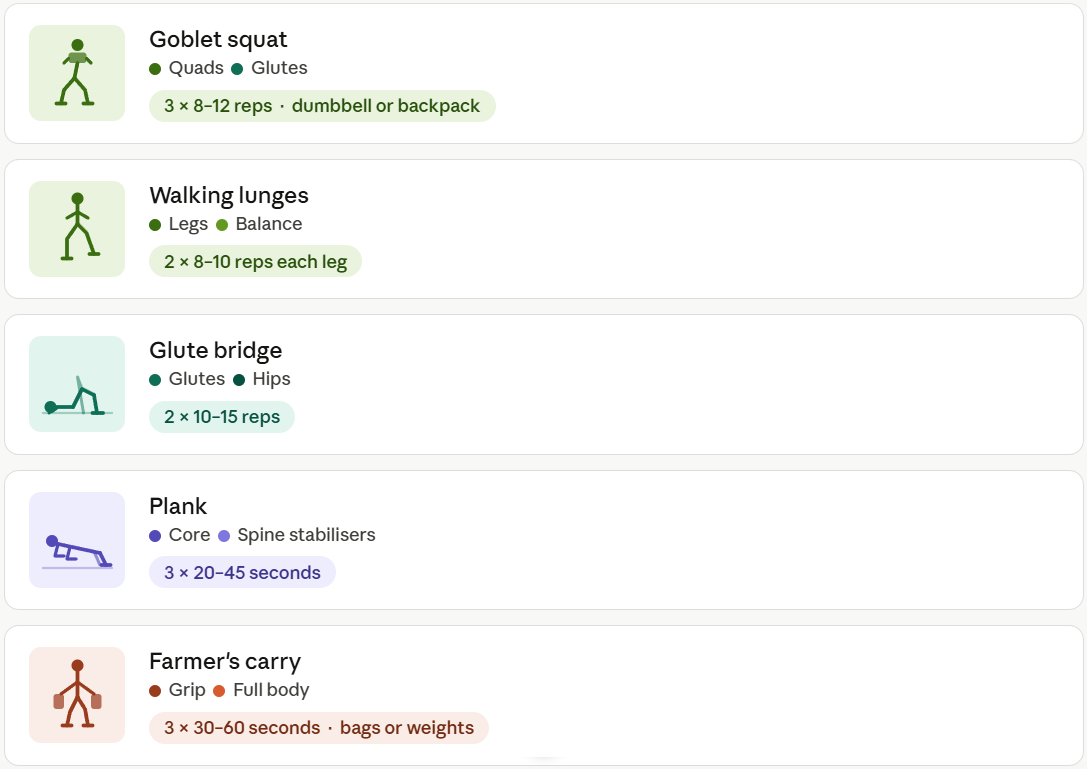
Session 2
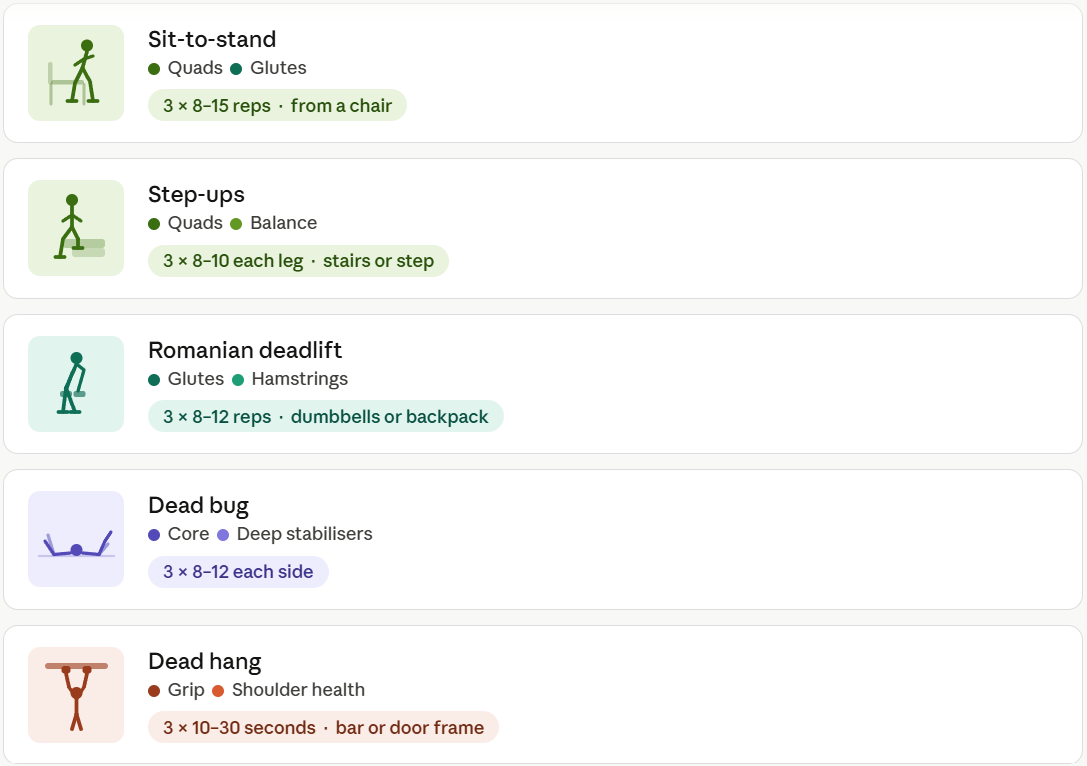
Note: this isn’t a bodybuilding programme. Feel free to add push-ups, rows, arms, or shoulder work - but from a pure longevity standpoint, the evidence is strongest for the four groups above. The rest is a bonus.
The Bottom Line
The evidence is clear: building strength is possible at any age - and it has the potential to transform how you age.
“I’m too old for this” couldn’t be further from the truth. If you’ve never trained before, starting now could mean not just feeling better today, but more healthy, independent years ahead.
Start embarrassingly small if you need to. Try one exercise from this list. You don’t need motivation to begin - motivation will come once you start.
Your future self will thank you.
Have a great weekend,
Ollie
Disclaimer: This post provides educational information based on scientific research and is not medical advice. It does not establish a doctor-patient relationship. Always consult a qualified healthcare professional before making lifestyle changes, addressing medical conditions, or starting new treatments.
As someone who’s 78 and still on the pickleball court most days, I can confirm every word of this. Grip, legs, glutes, core — that’s the whole game after 60. Not aesthetics, not “bulking,” not chasing numbers. Just the strength that lets you keep moving through the world without hesitation.
I’ve watched players lose these capacities one by one, and it’s never dramatic — it’s the slow fade you don’t notice until you suddenly do. The jar that won’t open, the fall that shouldn’t have happened, the stairs that feel steeper than last year.
The good news is exactly what you wrote: it’s all trainable. Even now. Especially now. A little consistent work keeps the wheels turning, the legs under you, and the confidence high.
People think aging is decline. Most of the time, it’s just disuse.
This is the kind of article I wish more older athletes — and their doctors — would read.
Loved this. You’re doing great work. I’m building Rational Wellness if you’re curious about more fitness and wellness ideas.