

Chronic Inflammation: An Underlying Driver of Age-Related Disease
5 evidence-based strategies for a lower-inflammatory lifestyle

Inflammation is often framed as something inherently harmful.
But it’s actually one of the body’s most important defence and repair systems.
Every day, the immune system uses inflammation to deal with viruses, injuries, and damaged cells.
When well regulated, it’s rapid, targeted, and short-lived.
But modern life has changed the equation.
Today, we’re constantly exposed to things our biology doesn’t recognise — or in amounts it wasn’t designed to handle.
As a result, many people now live with chronic low-grade inflammation: a persistent, often symptomless state that gradually shifts the body from repair toward damage.
Because this process plays a central role in many age-related diseases, addressing it at its root is both logical and actionable.

The Scale of the Problem
A simple way to understand chronic inflammation is as an emergency response system that never fully switches off.
When there’s a fire, alarms sound, sprinklers activate, and emergency services respond. It’s disruptive — but necessary. Once the threat is gone, everything returns to normal.
Now imagine it doesn’t.
The alarm continues quietly. The sprinklers keep leaking. Over time, the building begins to wear down.
Something similar can happen in the body.
When inflammatory signalling remains chronically elevated, it can increase oxidative stress, damage tissues, disrupt vascular function, and accelerate aspects of biological aging.
And this isn’t rare:
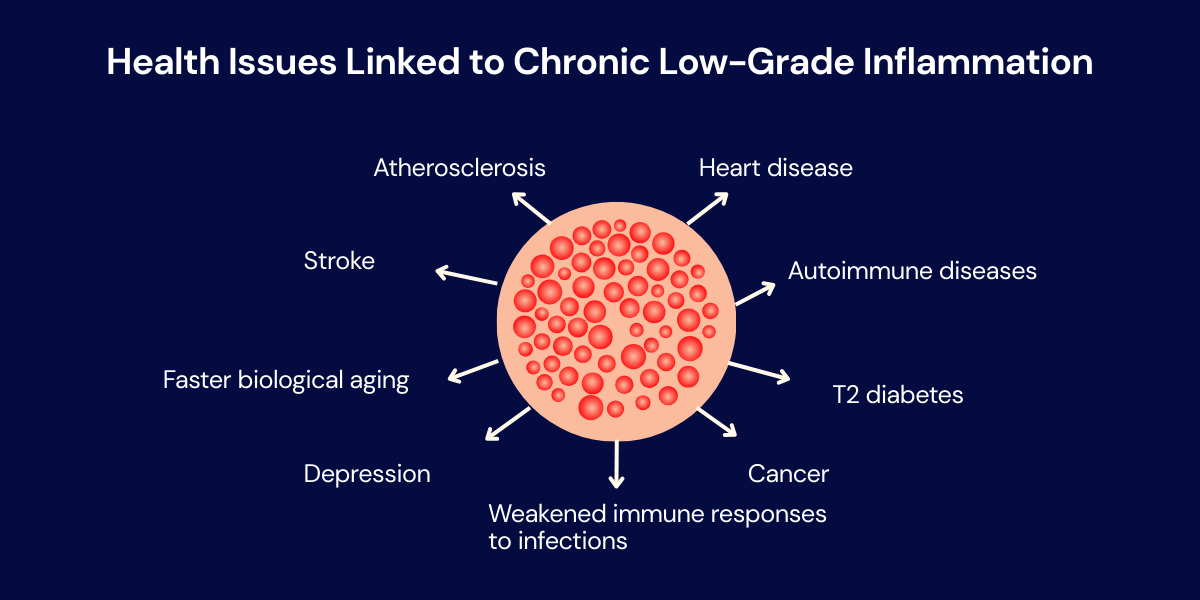
Diseases in which chronic inflammation plays a major role — including heart disease, stroke, and many cancers — account for more than half of all deaths worldwide.
Large population analyses also suggest that over a third of adults may have elevated inflammatory markers (such as hs-CRP).
Chronic inflammation isn’t the sole cause of these conditions — but it helps create the biological environment in which many of them develop and progress.
The Good News
Chronic inflammation is highly modifiable.
We know from twin studies that a large proportion of inflammatory variation is shaped by lifestyle — not just genetics.
But this isn’t a single-factor problem.
Inflammation is driven by a synergistic network of behaviours, meaning the solution must be too.
Drawing on research from immunology and longevity science, I’ve distilled this into 5 science-backed strategies to help you lower your inflammatory load:
Diet quality & food choices
Movement & physical activity
Metabolic health & body composition
Stress & psychosocial health
Environmental exposures
In the full guide, I break down the science behind each — and how to apply it to your own life.